November 17, 2026
My solar journey
From a white-light filter on a Fuji, through a Coronado PST and a Quark, to a spectroheliograph: three years of photographing our own star.
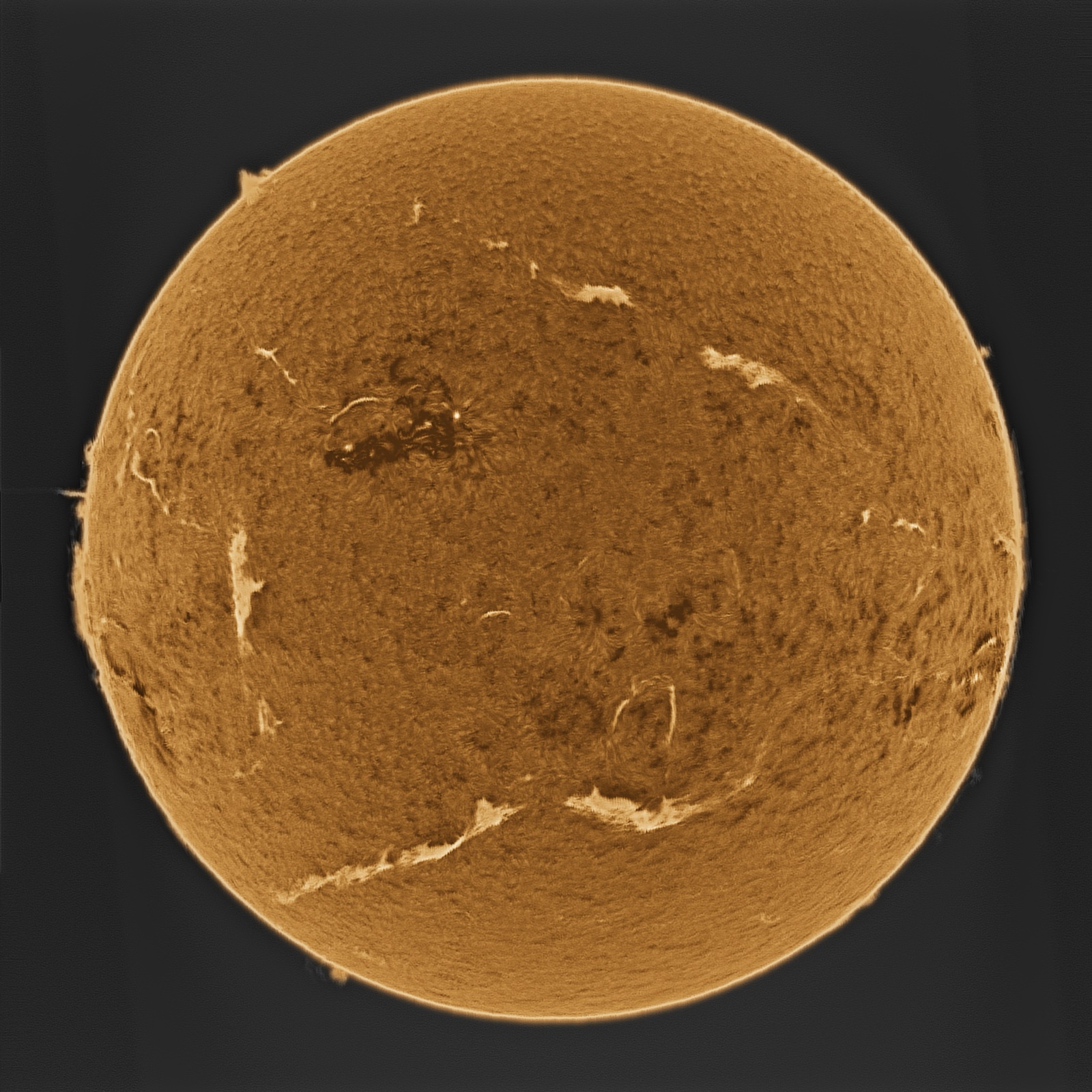
Deep-sky imaging happens at night, but there's a star you can photograph in the middle of the afternoon. The Sun changes every day, with sunspots, flares, filaments and prominences coming and going, so there's always something new to shoot. Here's how I got from a filter on a camera lens to a spectroheliograph. (And the usual warning: never look at or point anything at the Sun without a proper solar filter.)
White light
My first solar images, in the fall of 2023, were with the Fujifilm X-E3 behind a white-light solar filter. White light shows the Sun's surface, the photosphere: a bright disk with dark sunspots. I stacked the frames in AutoStakkert and sharpened them in RegiStax, the same way planetary imagers do. Around the same time the Seestar S50 arrived, with its own solar filter and a solar mode, which made a quick look at the day's sunspots almost effortless. That fall also brought the annular eclipse, and the total eclipse came the next spring (that's its own post).
Hydrogen-alpha
White light only shows the surface. Just above it is the chromosphere, a thin layer that glows in one deep red wavelength, hydrogen-alpha. Seeing it takes a very narrow filter, and the difference is dramatic: instead of a smooth disk, the whole Sun is covered in fine texture, with bright active regions, dark filaments and prominences arcing off the edge.
My first hydrogen-alpha scope came right after the annular eclipse: a used Coronado PST, a little 40 mm solar telescope with the filter built in. It was wonderful for looking at the Sun through the eyepiece, but not good at all for photography. That's why, in April 2024, I sold the PST and moved to a DayStar Quark Chromosphere, which fits on a regular telescope and works with a camera, paired with a ZWO ASI174MM. First light was April 21.
Three weeks later, the Sun put on a show. A huge sunspot group unleashed an enormous flare, and the solar storm that followed brought Northern Lights much farther south than usual.
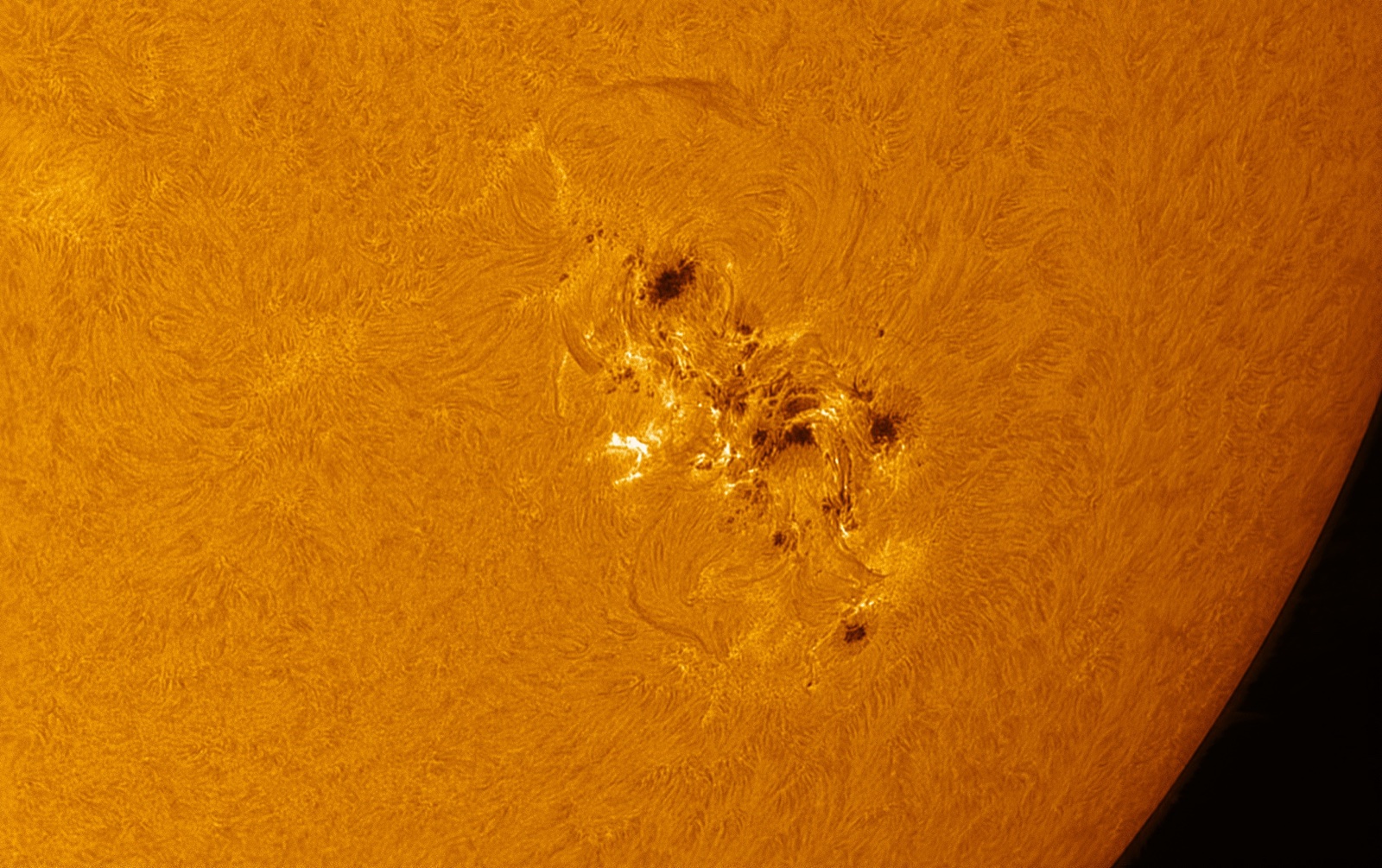
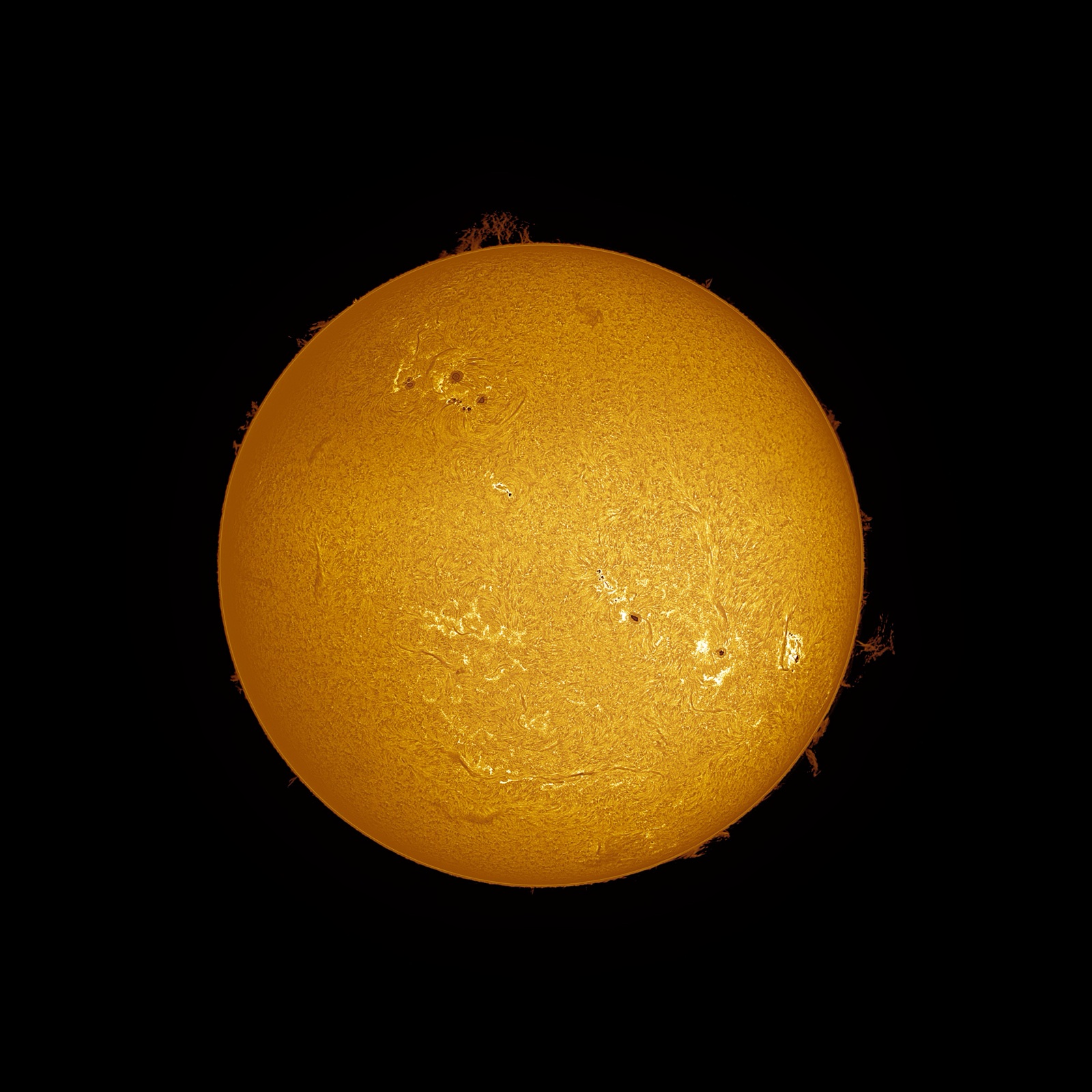
The Quark has a built-in 4.2x Barlow, so it's zoomed in much further than my deep-sky setup, and the whole Sun won't fit in one frame. Ten days later I made my first full-disc image as a 1x2 mosaic: one video of the top half of the Sun, one of the bottom, blended together. Getting good surface detail and good prominences from the same data turned out to be tricky, but it was a decent first try.
Chasing the ISS
With a solar rig set up, I started chasing International Space Station transits: the second or so when the ISS crosses in front of the Sun. Sites like transit-finder.com predict them, and there are several within driving distance of home every few weeks, each visible only along a narrow strip. After a first try on August 5, 2024, I set up in Alvarado on August 12 with the Quark on a William Optics Zenithstar 61 and a Sky-Watcher SolarQuest mount, and recorded high-speed video for about 20 seconds either side of the predicted time.
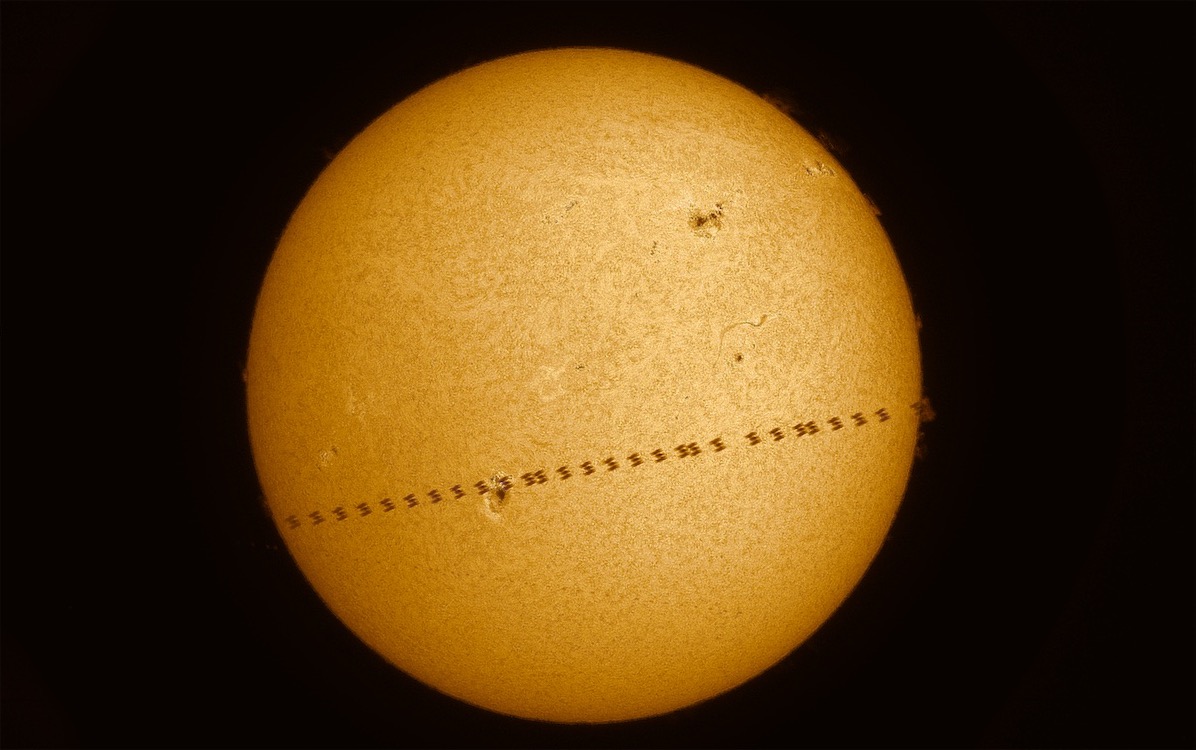
The image page for that one also has the transit as a short animation.
The spectroheliograph
In 2025 I sold the whole Quark rig (filter, camera and mount) to try a completely different approach: a spectroheliograph, or SHG. MLAstro, a Vietnamese company, had just introduced a beautifully engineered one, the SHG700. An SHG doesn't use a narrow filter at all. A slit lets in a thin slice of the Sun, and a diffraction grating spreads that slice into a spectrum. The camera records only the part of the spectrum you choose, like hydrogen-alpha.
Because it sees only one slice at a time, the telescope has to scan across the Sun while the camera records video at 240 frames per second. Software then rebuilds the full disk, one line per frame. The new setup is an SVBony SV48P refractor with the SHG700 and a ToupTek 678M camera on the AM5 mount, run by a small mini PC on the telescope. First light was June 22, 2025:
There's a lot more to learn with this one. The SHG can be tuned to other spectral lines too, which show different layers of the Sun's atmosphere, and that's where I'm headed next.