November 16, 2026
Forty hours on the Dumbbell Nebula with a Seestar
7,880 short exposures, a stalled stacking script, and a faint halo that only shows up with a lot of patience.
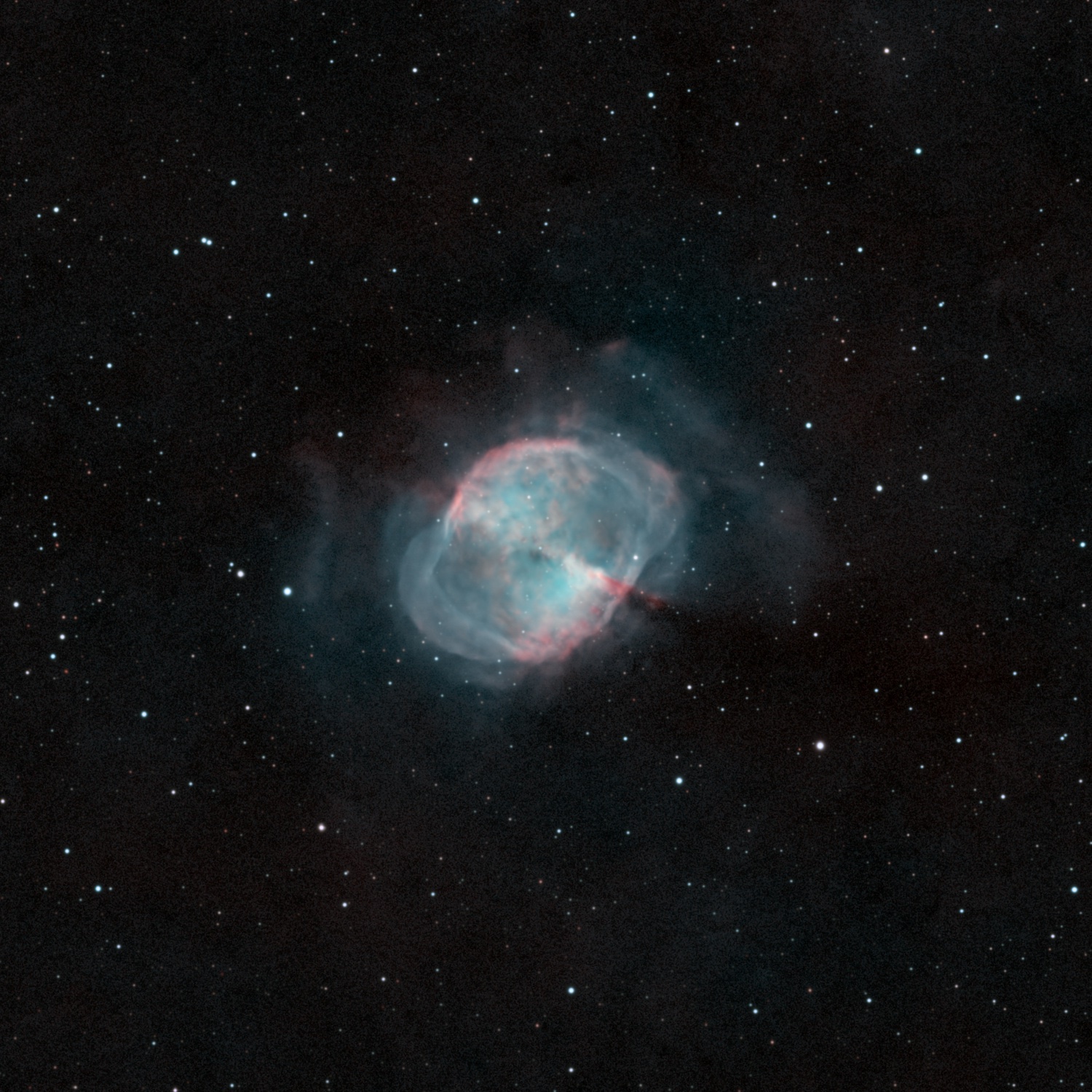
M27, the Dumbbell Nebula, is one of the brightest planetary nebulae in the sky, and its bright "apple core" shows up in almost any telescope. What most images don't show is the much fainter halo of gas around it. I wanted to see whether a little 50 mm Seestar S50, shooting from the middle of Dallas, could pick it up if I just gave it enough time.
The data
Over two weeks in September the Seestar collected 7,880 exposures of 20 and 30 seconds through its built-in dual-band filter. Grading every frame for sharpness, star shape, noise and cloud threw out 842 of them, mostly from the end of each night when M27 sank low in the west. That left a little under 40 hours.
When the stacking software gives up
PixInsight's WeightedBatchPreprocessing script normally does all the stacking for me. With 7,000 frames it got through debayering and then sat on one CPU core for an hour doing bookkeeping. So I ran the steps by hand instead: align every frame, normalize the background of each one, integrate them in four batches by night (one big batch kept crashing PixInsight), and then combine everything with a 2x drizzle, which sharpened the stars by about 20%.
Pulling out the halo
The halo is only about one or two standard deviations above the sky noise per pixel, so any leftover gradient would swamp it. That took three passes of background extraction (the last one after removing the stars) before the sky was flat enough. Then:
- Split the color image into hydrogen-alpha (red) and oxygen III (green + blue)
- Stretched both channels with the same curve, so the ratio between them stays honest
- Recombined them as HOO: hydrogen in red, oxygen in teal
- Added a little saturation and HDR compression to the core, so the inner lobes and red knots show
The teal loops outside the bright core are the halo: older gas the star threw off before it made the bright inner nebula. With 4.5 hours of data it was barely a hint; with 40 it's clearly there.
What I learned
- Smart telescopes can go surprisingly deep if you give them enough nights.
- Very large stacks need a manual workflow; the automatic scripts aren't built for them.
- For faint stuff, flattening the background matters more than any later processing step.